
WNBF Pro and Natural Bodybuilding Coach Steff Noble
Building a chest that genuinely stands out is not about gimmicks or random pump sessions. It is about intelligent programming, progressive overload, mechanical tension, and understanding how the chest actually works.
Below is one of my go-to chest sessions from the Pro Prep Coaching training vault, used with advanced natural athletes preparing for bodybuilding, physique, and performance-focused goals.
If you apply this session consistently for six weeks, I am confident you will notice a visible improvement in chest size, density, and overall development.
Here’s a favourite chest workout from pro prep coaching’s training vault!
| Exercise | Sets | Reps | Rest | Intensity |
| Bench Press | 5 | 5, 5, 3, 20 | 3 minutes | 90 %, 95%, 70% 1 RM |
| Weighted Dips | 3 | 8 | 2 minutes | 80% 1 RM |
| Incline Fly | 3 | 10 | 90 seconds | 75% 1 RM |
| Cable Crossover | 3 | 12 – 15 | 60 seconds | Last Set Drop Set |
| Press Ups | 1 | Failure | – | Press up to failure |
Why This Chest Session Works
This session balances:
- Heavy mechanical tension
- Moderate hypertrophy ranges
- High-rep metabolic stress
- Intelligent fatigue management
It also progresses through compound to isolation movements, allowing you to load the chest hard early while finishing with targeted fatigue.
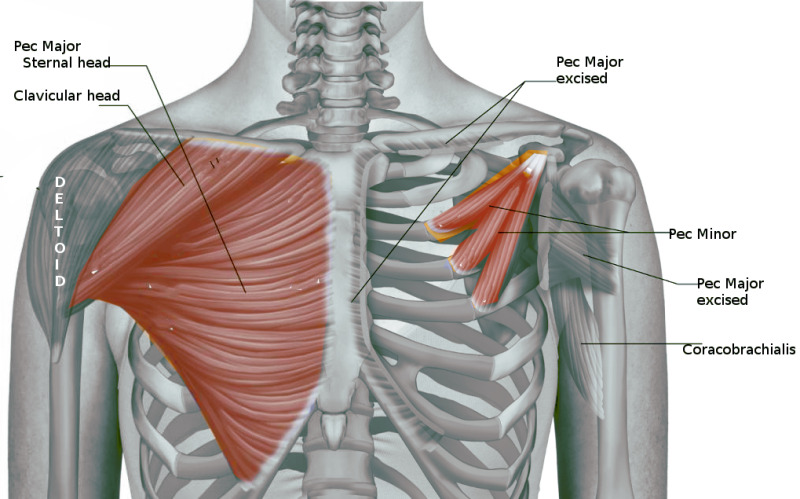
Anatomy of the Chest
Anatomy of the Chest
The chest consists of two primary muscles:
Pectoralis Major
A large fan-shaped muscle responsible for:
- Shoulder flexion
- Horizontal adduction
- Internal rotation of the arm
This is the muscle responsible for chest size, shape, and density on stage.
Pectoralis Minor
A smaller muscle located beneath the pec major. It assists with scapular protraction and depression. While not visible, it contributes to shoulder mechanics and pressing stability.
Chest-dominant sessions are often referred to as press days because pressing movements heavily involve both muscles.
How to Train the Chest Properly
Incline, Flat, and Decline Positions
Using multiple pressing angles allows you to target the chest more completely.
- Incline presses emphasise the upper chest
- Flat presses distribute load across the pecs
- Decline presses bias the lower chest
There is a popular belief that female athletes should only train incline pressing due to stage presentation. In reality, well-rounded development still matters, particularly for structure, fullness, and transitions.
Dumbbells
Dumbbells allow:
- Greater range of motion
- Increased stretch under load
- Improved unilateral control
They are excellent for hypertrophy and shape but typically limit absolute loading due to instability.
Machines
Machines such as:

- Cable crossovers
- Pec deck
- Chest press machines
- Smith machines
Allow you to isolate the chest safely and efficiently. They are especially useful for advanced training techniques such as drop sets, rest-pause, and extended sets.
Fly variations are particularly effective for targeting the chest-shoulder tie-in.
Barbells
Barbell movements allow the greatest loading potential and remain foundational for chest development.
Key movements include:
- Barbell bench press
- Weighted dips
- Chest-focused push ups
Dips are often called the upper-body squat for good reason. They allow serious loading and develop thickness through the chest, shoulders, and triceps.
If you want mass, this is where it happens.
Considerations for rep ranges and advance training techniques
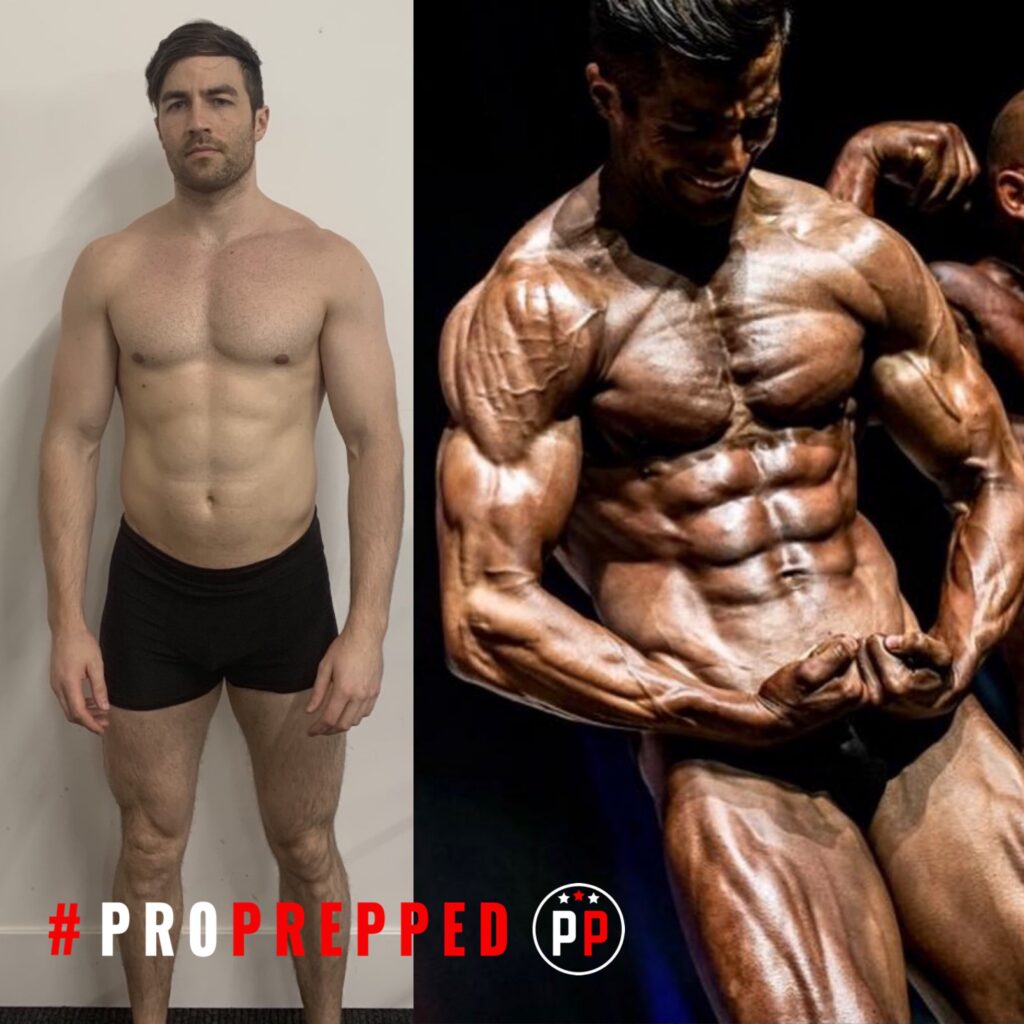
Pro Prep Client Transformation
Much has been written about rep ranges, and you should alter your rep range depending on your goal, e.g. strength hypertrophy endurance. However, I would say that if you want to improve your overall chest development then you need to increase your 1, 3, 5, 8, 10, 12, & 20 repetition max. Essentially you need to train all the rep ranges and you need to get good at them all. That doesn’t mean doing singles as part of your training plans, but it does mean that you have to spend some time lifting heavier and lighter. Using percentages of your 1 rep maximum (1RM) is a great way of doing this, alongside using scales like reps in reserve (RIR) or rate of perceived exertion (RPE). Moreover, with any plan, particularly bodybuilding you’re going to want to do some advanced training techniques, probably 1 or 2 per session as muscle mass is built as a consequence of mechanical tension, metabolic stress and muscle damage.
Percentages of 1RM
Using percentages of your 1RM allows for consistent progress tracking and the ability to target specific training goals. For example, training with lighter weight at a lower percentage of your 1RM (e.g. 60-70%) can help build endurance, while training with heavier weight at a higher percentage of your 1RM (e.g. 80-90%) can help improve muscle strength. The great thing about percentages is they can keep you honest. The numbers don’t lie. If your program says use 80% of your 1RM then you know what out need to do. Moreover it allows you to track your progress by comparison to your 1RM.
Advanced Training Techniques
Advanced training techniques, such as supersets, negatives, rest-pause, cluster sets, and partials, can help increase intensity and provide a greater training stimulus. For example:
- Supersets involve performing two exercises back-to-back with minimal rest in between, increasing the overall volume and intensity of your workout. You can do them agonist to antagonist muscles or across the same muscle group. Fly’s combined with press ups for example work well.
- Negatives involve performing the eccentric (lowering) portion of an exercise with a slow, controlled motion, putting extra stress on the muscles and promoting muscle growth. These are great if you want to test yourself and get used to handling a lot of weight. you can load up a bar with 110 to 120% of your 1RM and just practice the decent on a bench press. Make sure you have a spot though!
- Rest-pause involves performing a short set, resting briefly, and then repeating the same set, leading to increased muscle fatigue and a greater training stimulus. These are great if you’re stuck trying to progress with a rep range. Say you want to hit a set of 10 on the bench but can only manage 8 before you fail. The trick is to rack the weight at 8 reps, take a 10 to 20s rest and then try to push out another couple of reps. that way you get your ten over the course of a rest pause set. Over a few weeks you should hopefully be able to get the 10 without the pause.
- Cluster sets involve performing multiple reps with short rests in between, allowing for heavier weight to be used and promoting strength gains. These are structured rest pause sets. Great for getting strong. check out the scheme below for the explanation on how to perform them. For chest training though you probably want to stick with barbells and machines here, to save you messing about with dumbbells.
- Partials involve performing only a portion of the range of motion of an exercise, allowing for heavier weight to be used and targeting specific parts of a movement. This is a classic powerlfiting technique. You might be strong or weak at a specific point in the movement so with partials you can focus on that phase of the lift. Obviously if you can move past sticking points this can help you excel in all the rep ranges.
- Bands, Chains and Unstable Bars covers a broad range of training styles typically used to increase strength, or stability in the bench press. Similarly to partials, the addition of chains or bands allow the trainer to work harder at specific parts of a lift where you might want to make something harder or easier.
What Exercises are best?
Depends on the goal of the program and the individual, you’ll incorporate a variety of the aforementioned movements and techniques There’s a lot to consider and I talked extensively about this in the bicep training article (https://proprepcoaching.com/bodybuilding/building-big-arms-how-to-program-to-make-them-even-bigger/). If I was pressed though…(pun intended) I’d always er towards the use of the barbell bench press as a great exercise for any chest program for the following reasons.
The barbell bench press is used to increase muscle mass in the upper body rather than specifically to the pectoralis major. Although you sometimes might break a training programs down into body part specific days e.g. chest, shoulders, arms etc. I always suggest focusing on compound moves for the following reasons:
A) These exercise usually provide the most bang for their buck for the primary muscle group as well as the auxiliary muscles, (something which is important for frequency considerations)
B) With A in mind, a focus on these lifts based on judging experience usually leads to a far more symmetrical physique, they just seem to flow better. This often happens because compound lifts like bench press hit the shoulders, triceps, forearms, upper back, and core training leading to greater overall development compared to say using a chest press machine. Moreover, this is probably why you see people with poor technique suffering from poor symmetry.
C) To develop a classic physique, I’m a big fans of utilising free weights in keeping with golden era principles. Those guys looked great and that’s all they had. That’s not to say that we can’t use machines and every individual has different needs (injuries are a consideration), but free weights form the cornerstone of a golden era approach to programming.
The best movements and Muscle Activation Research

Activation is another interesting question, Electromyographs (EMG) allow you to measure muscle activation across a muscle while exercising. Muscle activation and force production is greater with stable vs unstable loads. Moreover, exercise intensity in terms of RPE is usually greater with stable surfaces. All this makes sense, if you have a solid surface to press from and you don’t have to worry about balancing anything then you can put more into lifting a weight. The ability to produce a high RPE seems to be essential for hypertrophy independent of the load and high degrees of mechanical tension are also know to be important. Hence why a movement like a barbell bench press is favoured. Although it’s not quite as clear cut as you think.

Here’s a sample of some studies representative of the area:
No difference between motor unit activation between Dumbbell flys, Dumbbell chest press, Barbell Bench Press.
Welsch, E.A., Bird, M. and Mayhew, J.L., 2005. Electromyographic activity of the pectoralis major and anterior deltoid muscles during three upper-body lifts. Journal of Strength and Conditioning Research, 19(2), p.449.
EMG Activation is related to the instability of the exercise, where barbell and bench conditions perform better than dumbbell and swiss ball conditions.
Kohler, J.M., Flanagan, S.P. and Whiting, W.C., 2010. Muscle activation patterns while lifting stable and unstable loads on stable and unstable surfaces. The Journal of Strength & Conditioning Research, 24(2), pp.313-321.

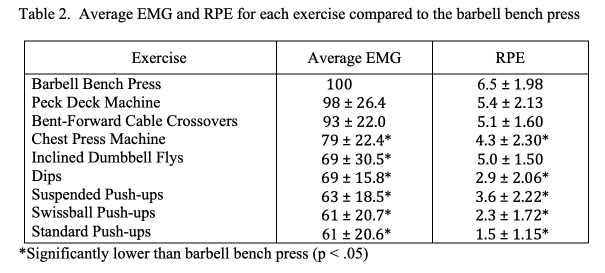
Barbell bench press EMG and RPE activation is greatest by comparison to eight other chest exercises
Schanke, W., 2012. Electromyographical analysis of the pectoralis major muscle during various chest exercises(Doctoral dissertation).
Stable loads result in similar EMGs in pectoralis major with Dumbbell, barbell and smith machine, although triceps EMG activation is greater in barbell vs dumbbell and smith machines
Saeterbakken, A.H., van den Tillaar, R. and Fimland, M.S., 2011. A comparison of muscle activity and 1-RM strength of three chest-press exercises with different stability requirements. Journal of sports sciences, 29(5), pp.533-538.
Flat vs incline vs decline bench press variation indicates limited difference on pectoralis major activation although influences bicep EMG, while grip variations affect triceps EMG. Flat, medium and wide grip variations are suggested for greatest 6 RM loads.
Saeterbakken, A.H., Mo, D.A., Scott, S. and Andersen, V., 2017. The effects of bench press variations in competitive athletes on muscle activity and performance. Journal of human kinetics, 57(1), pp.61-71.
Wider Grips vs narrow grips result in the greatest pectoralis major activation. Hence the need to alter the grip when hitting the triceps.
Jagessar, M. and Gray, M., 2010. Optimizing development of the pectoralis major. Sport Journal, 13(1), p.7.
Muscle activity changes with exercise intensity, velocity of movement, fatigue, mental focus, movement phase and stability conditions, such as bar vibration or unstable surfaces. The most important factor for EMG activation is exercise intensity. E.g external load or RPE.
Stastny, P., Gołaś, A., Blazek, D., Maszczyk, A., Wilk, M., Pietraszewski, P., Petr, M., Uhlir, P. and Zając, A., 2017. A systematic review of surface electromyography analyses of the bench press movement task. PloS one, 12(2).
Finally, the program laid out at the outset is for the advanced trainer. If you’re new to training you’ll probably get by just nicely by doing between 5 to 9 sets per week for chest. Use the information in this article and you’ll be able to put together an effective training program. If however you’ve been training for a few years and fancy giving it a go, then I’d simply suggest warming up appropriately and perhaps including some sort of deloading component every 4 to 6 weeks.
Want Help Programming Your Training?
If you want specific coaching that is:
- Evidence-based
- Natural bodybuilding focused
- Individualised to your structure and goals
Then head to the Pro Prep Coaching sign-up page and we will be in touch.
👉 https://proprepcoaching.com/sign-up/
Train smart. Train hard. Build a physique thats for life.